DSH canvas · Category Design · v1 · 2026 · 90 minutes

The Category Design Canvas

Stop competing in someone else's category. Name your own. Nine boxes that take you from a painful problem to a named category you can lead — problem, customer, landscape, point of view, solution, name, business model, category lead and the unfair advantage that makes it defensible.

StrategyPositioningFoundersFree · watermarkedPack · clean + 4K PNG
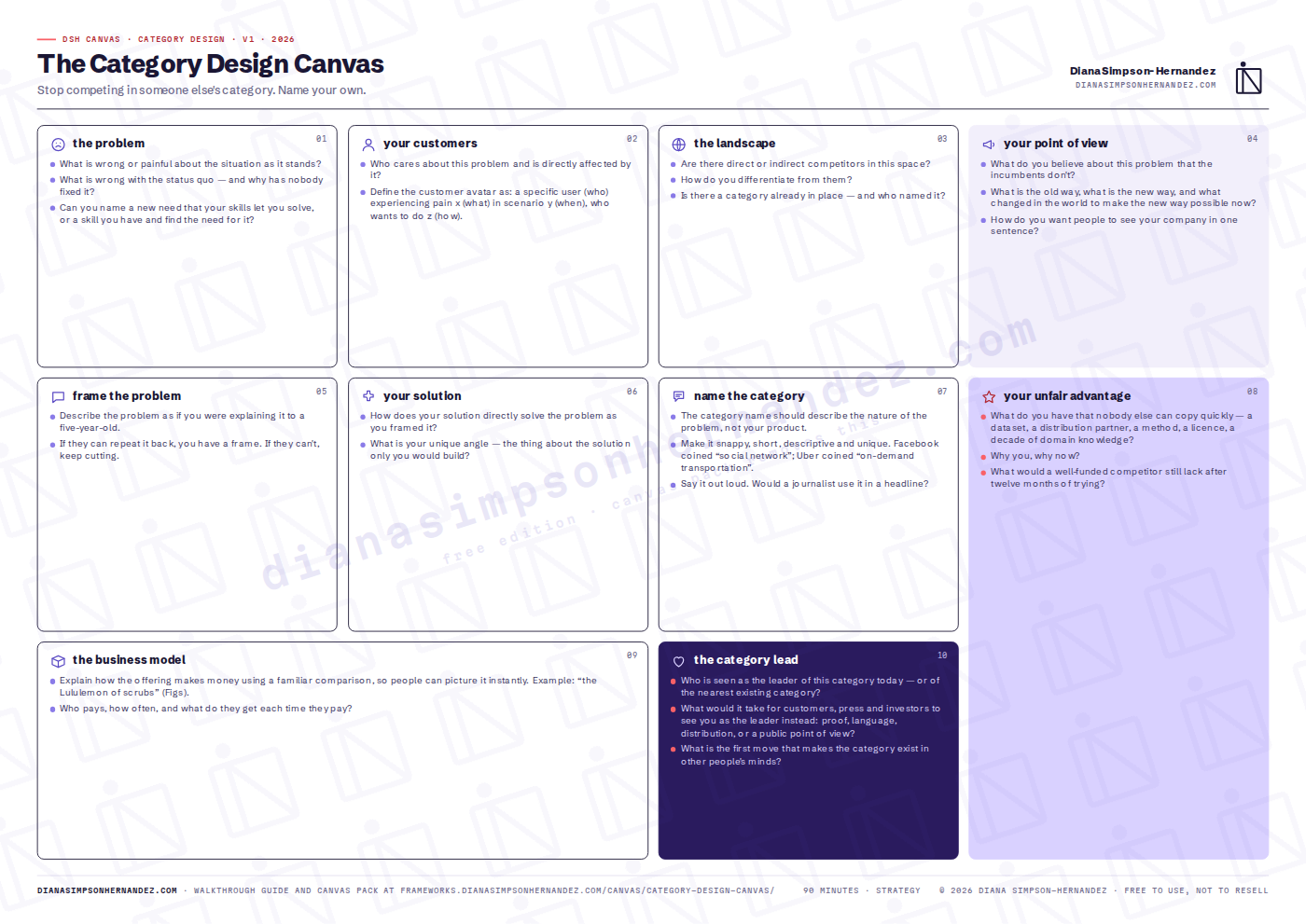
The Category Design Canvas — preview
What it does

Why this canvas exists

Category design is the discipline of creating and naming the market you want to win, rather than fighting for share of one that already has a leader. The canvas forces a specific sequence: understand the problem and the person before you touch the solution, take a public point of view before you take a name, and prove you can defend the category before you announce it. Most positioning work goes wrong because it starts in the middle — with the product — and works outwards. This canvas starts at the edges.

Reach for it when
  • You are launching something genuinely new and the existing labels make it sound like a cheaper version of an incumbent.
  • You keep losing deals on price, which usually means you are being compared inside someone else's category.
  • Investors or partners describe your company in words you would never choose.

Built for: Founders and product leads positioning a new product, or repositioning one that is losing on price.

On the canvas

What you fill in

Work the boxes in the numbered order. The order is the method.

01

the problem

What is wrong or painful about the situation as it stands?

02

your customers

Who cares about this problem and is directly affected by it?

03

the landscape

Are there direct or indirect competitors in this space?

04

your point of view

What do you believe about this problem that the incumbents don't?

05

frame the problem

Describe the problem as if you were explaining it to a five-year-old.

06

your solution

How does your solution directly solve the problem as you framed it?

07

name the category

The category name should describe the nature of the problem, not your product.

08

your unfair advantage

What do you have that nobody else can copy quickly — a dataset, a distribution partner, a method, a licence, a decade of domain knowledge?

09

the business model

Explain how the offering makes money using a familiar comparison, so people can picture it instantly. Example: “the Lululemon of scrubs” (Figs).

10

the category lead

Who is seen as the leader of this category today — or of the nearest existing category?

Get it

Free edition, or the pack

The free edition is the whole canvas — nothing held back except the watermark. The pack is for people who will run it more than once and want it clean, in Miro, with the full guide.

Free edition

Download and run it today£0

The full canvas at A3 with every prompt, and a two-page quick guide. Watermarked with the DSH mark, otherwise complete.

  • The Category Design Canvas — A3 PDF, watermarked
  • Quick guide — what it is, when to use it, the box-by-box short version
  • No email required

Print at A3 landscape. Or open the PDF in Miro / FigJam as a board background.

Box by box

The short version

The full guide in the pack adds what good looks like for each box, a worked example, the agenda and the mistakes.

01the problem — Write the pain in the customer's words, not yours. Then write what is wrong with how it is handled today.
02your customers — Fill the avatar sentence: who, what pain, when, and what they want to do instead. One person, not a segment.
03the landscape — List the direct and indirect alternatives, including doing nothing. Name the category they sit in and who is credited with it.
04your point of view — State the belief the incumbents don't hold, the old way versus the new way, and what changed in the world to make the new way possible now.
05frame the problem — Explain it to a five-year-old. Read it aloud to someone outside your industry and ask them to repeat it.
06your solution — Now, and only now, describe the solution — as the direct answer to the frame, and with the angle only you would take.
07name the category — Draft five names. Each must describe the problem space, not the product. Test each in a fake headline.
08your unfair advantage — List what you have that a well-funded competitor would still lack after a year: data, distribution, method, licence, domain knowledge.
09the business model — Use a familiar comparison so anyone can picture how you make money, then state who pays, how often, and for what.
10the category lead — Name who is seen as the leader today, what it would take to displace them in the minds of customers and press, and the first public move that makes your category exist.
What next

After the canvas

Take the named category and the unfair advantage into the FLYWHEEL canvas to score whether the business behind it can compound, and into REWIRED if the thing holding it back is the operator rather than the strategy.

Can I use this with clients?

Yes — both editions. Run it in your workshops, your company and your client work. The one thing you can't do is resell the files or upload them to template marketplaces.

What does the watermark look like?

A light tiled DSH mark and the site address across the sheet. Prompts, boxes and layout are identical to the pack version. The preview above is the free edition.

Miro or FigJam?

The pack includes a 4K PNG of each canvas. Drop it on a board, lock it, and put sticky notes on top.

Do I get updates?

Pack buyers get every new version of every canvas by email. The free edition is always the current version on this page.

The collection

The other canvases