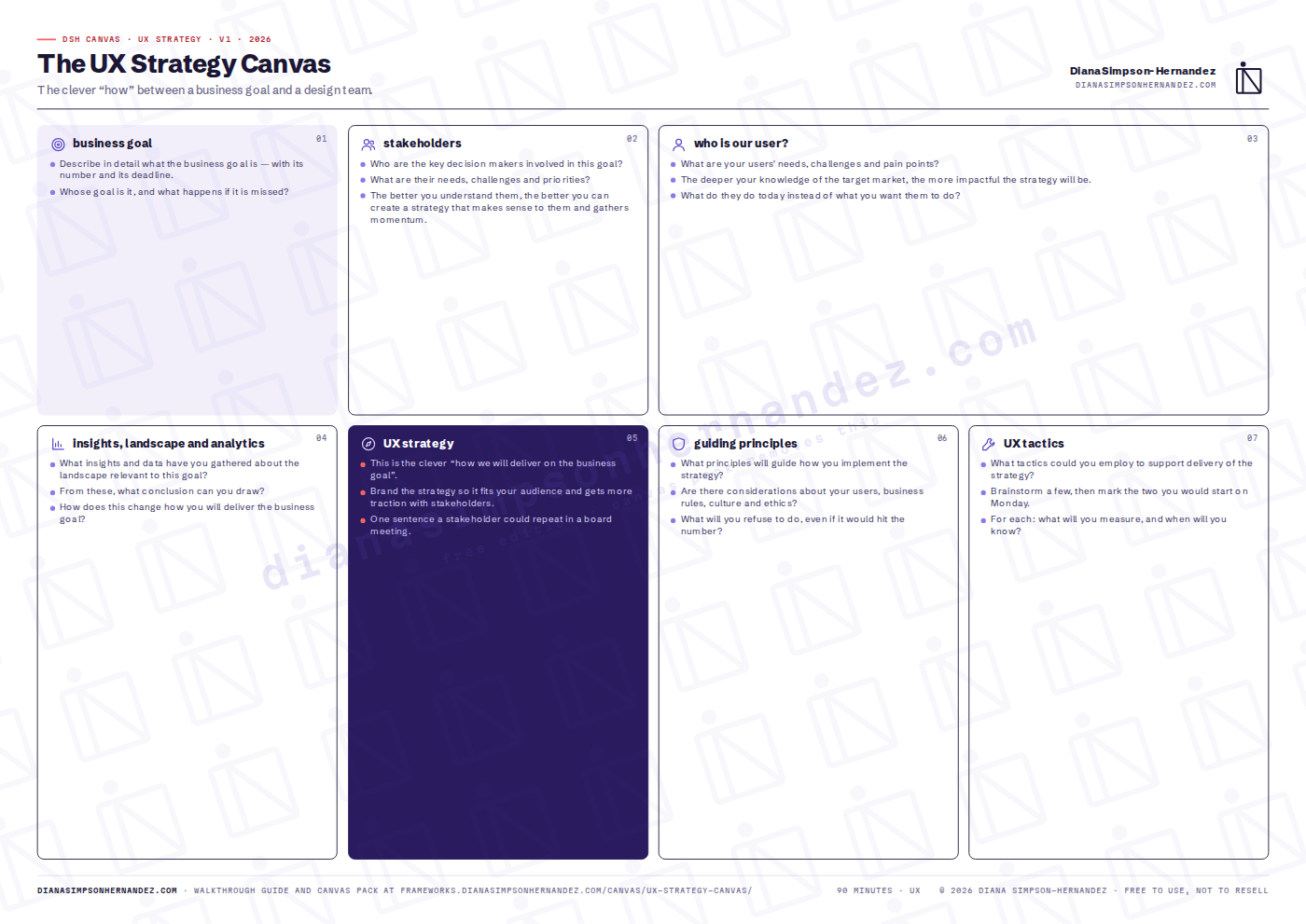
The clever “how” between a business goal and a design team. Seven boxes that turn a business goal into a UX strategy stakeholders will back: goal, stakeholders, user, insights and analytics, the strategy itself, guiding principles, and the tactics that deliver it.
A UX strategy is the bridge between a business goal expressed as a number and a design team expressed as a backlog. Without it, design work is judged on taste and delivered late. The canvas insists that you understand the goal and the people who own it before you describe users, that you draw a conclusion from evidence before you write a strategy, and that the strategy is branded — given a name and a sentence — so that people outside the design team can carry it into rooms you are not in.
Built for: Design leads, heads of product and anyone who has to explain what UX is going to do about a revenue number.
Work the boxes in the numbered order. The order is the method.
Describe in detail what the business goal is — with its number and its deadline.
Who are the key decision makers involved in this goal?
What are your users' needs, challenges and pain points?
What insights and data have you gathered about the landscape relevant to this goal?
This is the clever “how we will deliver on the business goal”.
What principles will guide how you implement the strategy?
What tactics could you employ to support delivery of the strategy?
The free edition is the whole canvas — nothing held back except the watermark. The pack is for people who will run it more than once and want it clean, in Miro, with the full guide.
The full canvas at A3 with every prompt, and a two-page quick guide. Watermarked with the DSH mark, otherwise complete.
Print at A3 landscape. Or open the PDF in Miro / FigJam as a board background.
All five canvases, clean and print-ready, with the full walkthrough guides. Buy once, use it in every workshop you ever run.
Secure checkout by Lemon Squeezy. Instant download. VAT handled at checkout. Single-team licence — run it on your company and your clients, don't resell it.
The full guide in the pack adds what good looks like for each box, a worked example, the agenda and the mistakes.
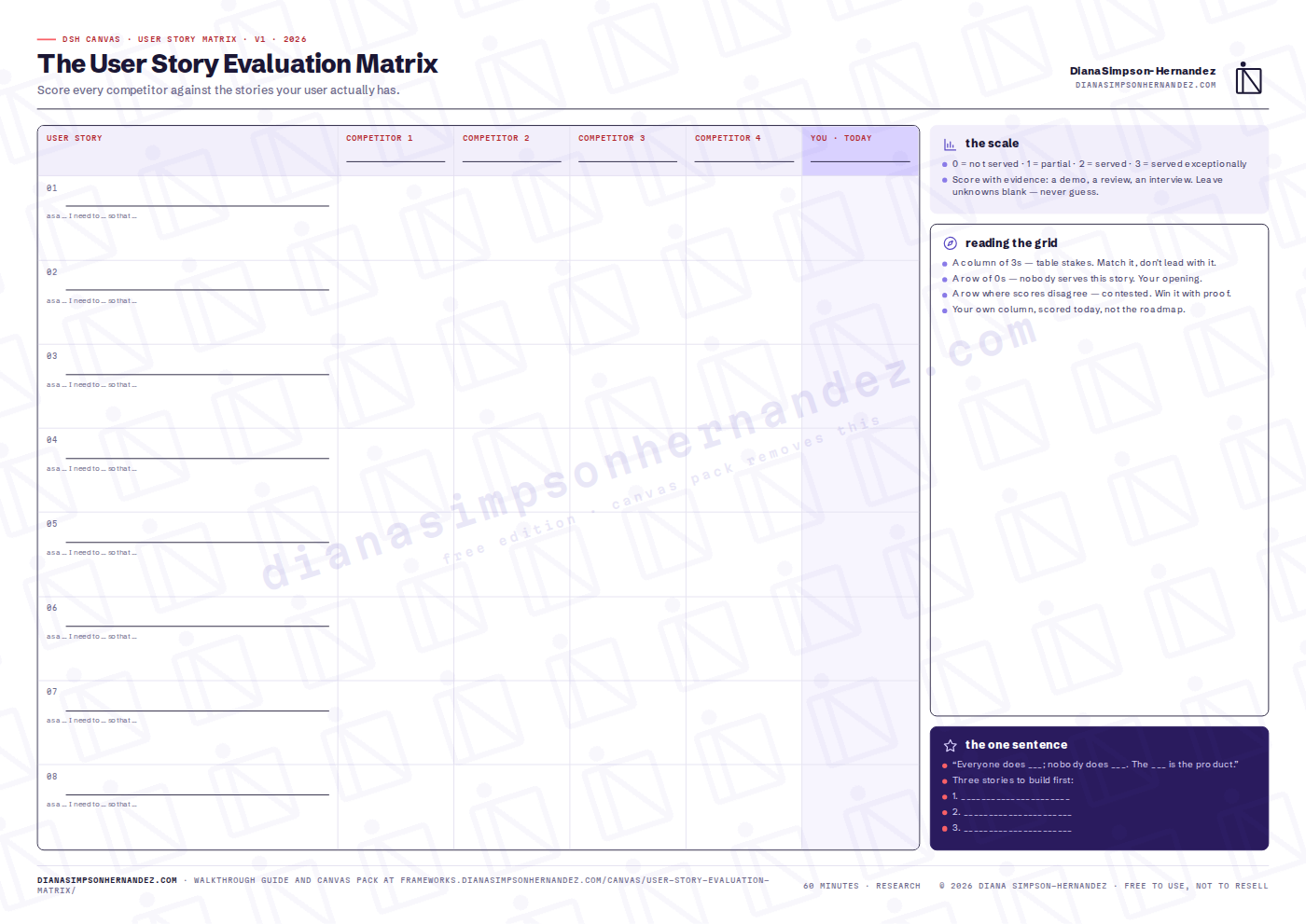
Run the Empathy Canvas on the user box if it was thin, and use the User Story Evaluation Matrix to check the tactics against what competitors already do.
Yes — both editions. Run it in your workshops, your company and your client work. The one thing you can't do is resell the files or upload them to template marketplaces.
A light tiled DSH mark and the site address across the sheet. Prompts, boxes and layout are identical to the pack version. The preview above is the free edition.
The pack includes a 4K PNG of each canvas. Drop it on a board, lock it, and put sticky notes on top.
Pack buyers get every new version of every canvas by email. The free edition is always the current version on this page.
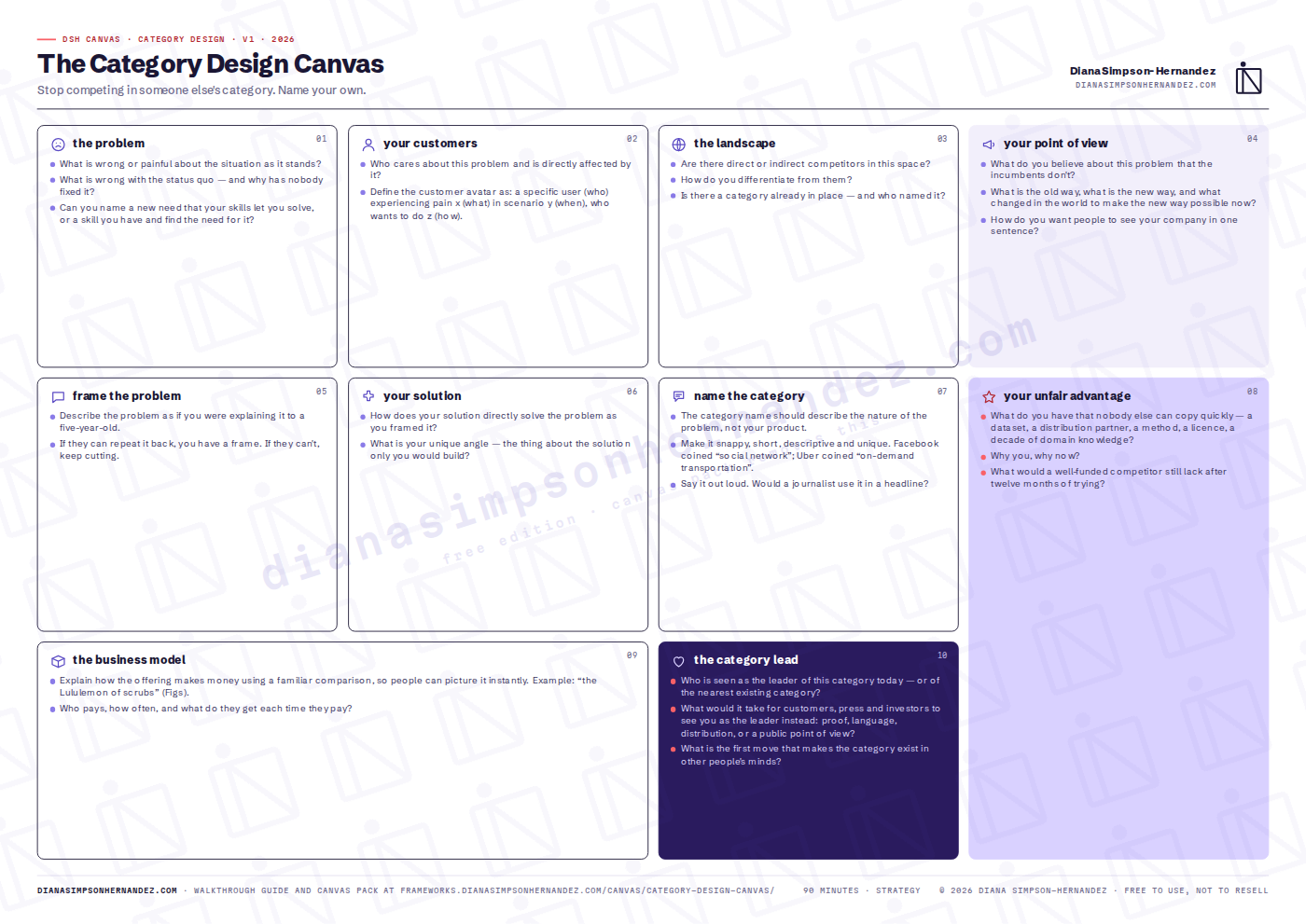
Stop competing in someone else's category. Name your own.
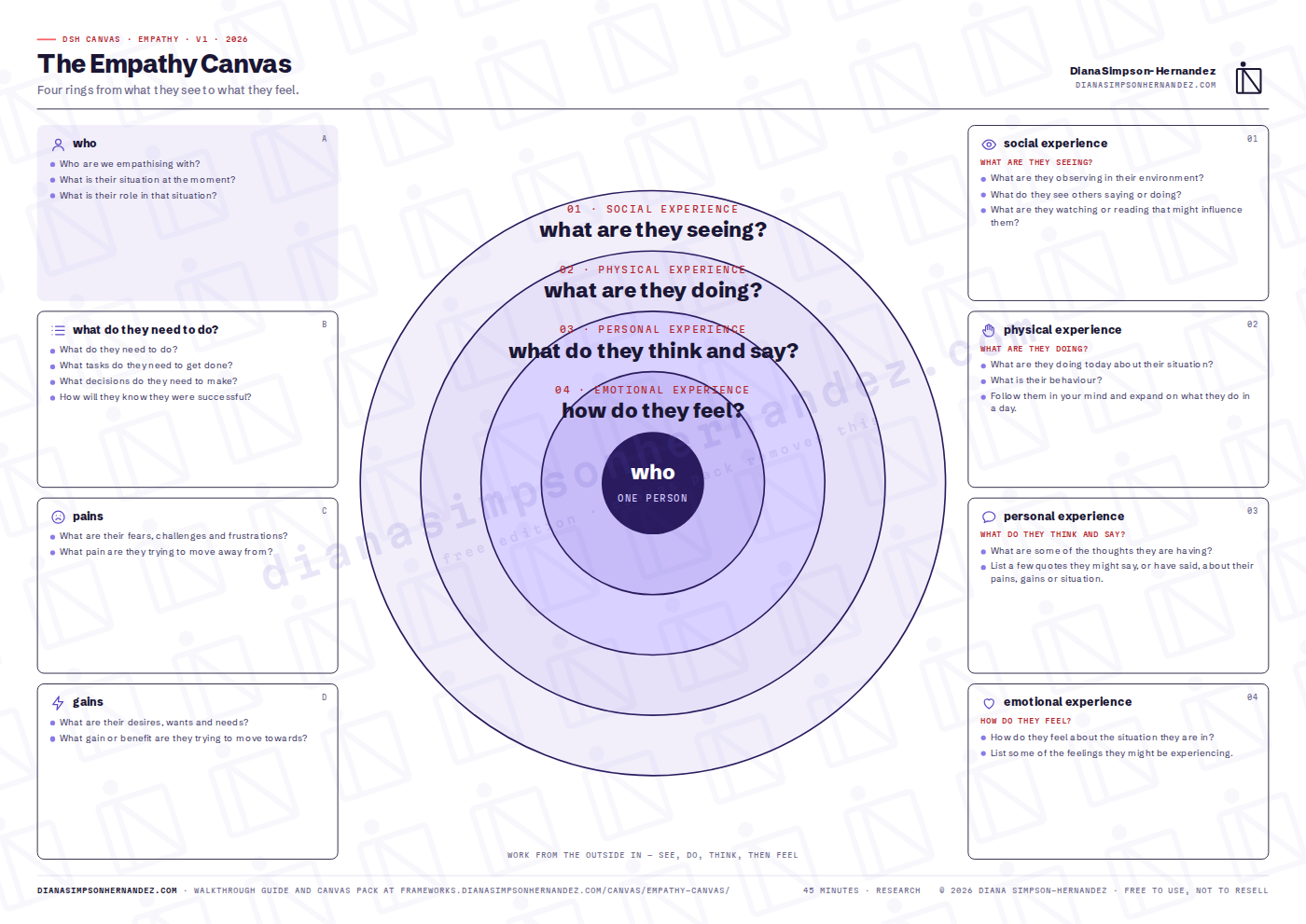
Four rings from what they see to what they feel.
Score every competitor against the stories your user actually has.
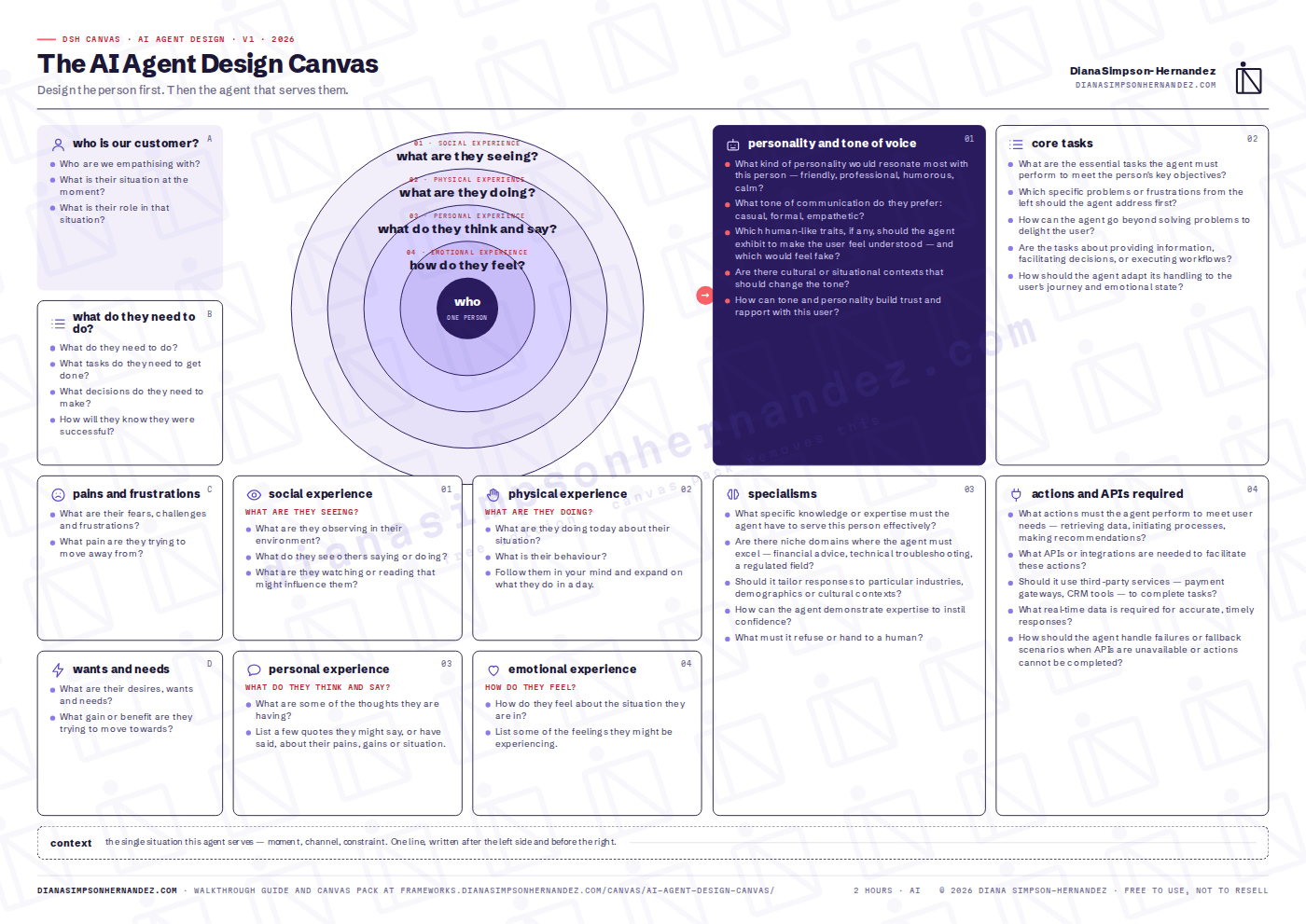
Design the person first. Then the agent that serves them.