DSH canvas · User Story Matrix · v1 · 2026 · 60 minutes

The User Story Evaluation Matrix

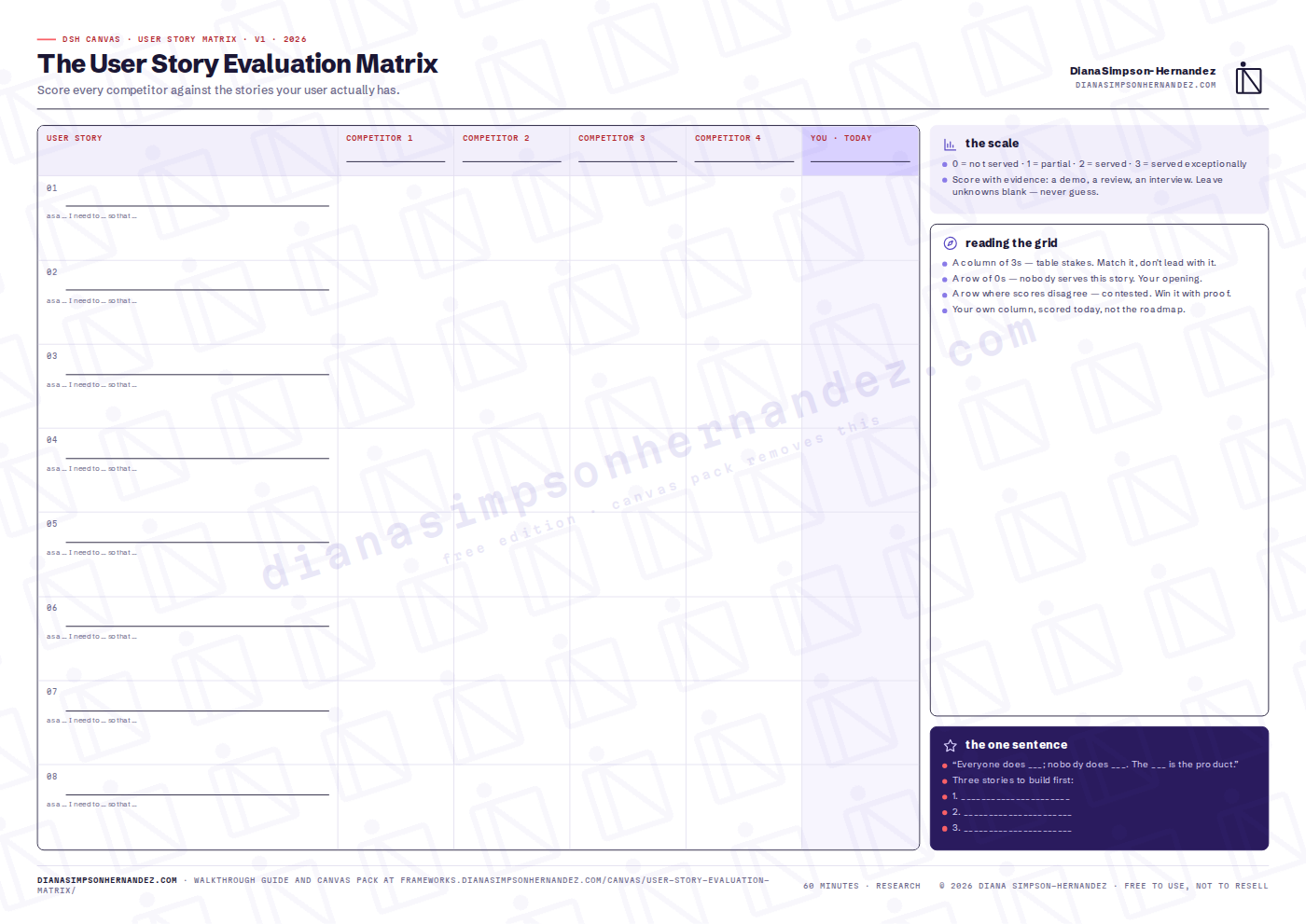
Score every competitor against the stories your user actually has. A grid: your user stories down the side, competitors across the top. Score how well each alternative serves each story, and the gaps become your roadmap and your positioning in one move.

ResearchCompetitiveProductFree · watermarkedPack · clean + 4K PNG
The User Story Evaluation Matrix — preview
What it does

Why this canvas exists

A competitive analysis that starts from the user rather than the feature list. Down the side go the user stories you learned from research — “as a [who], I need to [what] so that [why]”. Across the top go the real alternatives, including the spreadsheet and doing nothing. Each cell is scored on how well that alternative serves that story. The pattern in the grid tells you three things at once: where every competitor is strong (table stakes you must match), where they are all weak (your opening), and which stories nobody else has even noticed (your category).

Reach for it when
  • Before committing a roadmap, to check you are building where the gap is.
  • When a competitive slide is needed for investors or a board and the usual feature checklist feels dishonest.
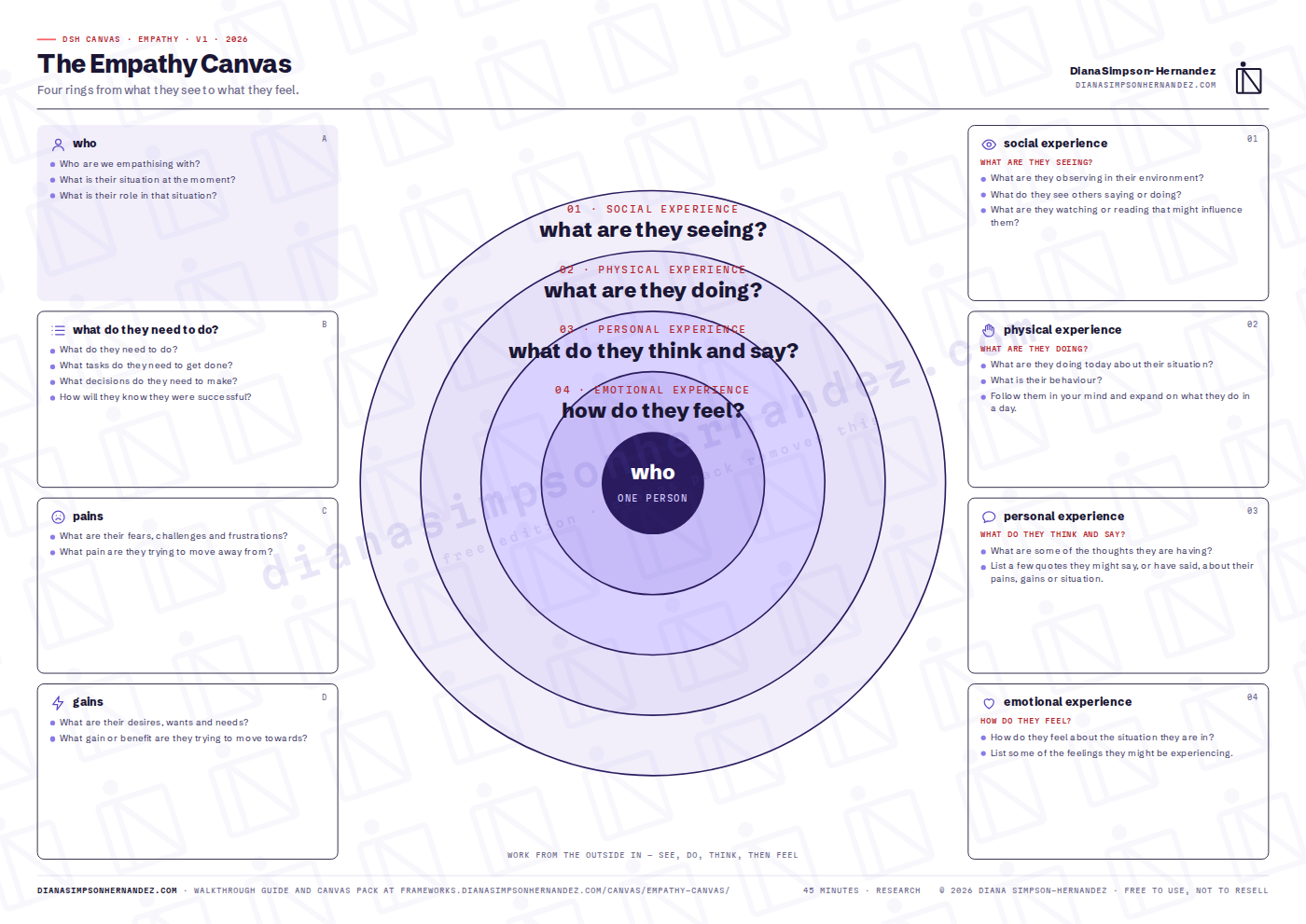
  • After an empathy canvas or interview round, to turn stories into priorities.

Built for: Product managers and founders deciding what to build first, and anyone writing a competitive slide that needs to be true.

On the canvas

What you fill in

Work the boxes in the numbered order. The order is the method.

01

the rows

Your user stories, from research: as a [who], I need to [what], so that [why].

02

the columns

Every real alternative — direct, indirect, the spreadsheet, doing nothing.

03

the scores

0 = not served · 1 = partial · 2 = served · 3 = served exceptionally

04

your column

Yourself, scored today, not the roadmap.

05

reading the grid

Columns of 3s are table stakes; rows of 0s are your opening; rows that disagree are contested.

Get it

Free edition, or the pack

The free edition is the whole canvas — nothing held back except the watermark. The pack is for people who will run it more than once and want it clean, in Miro, with the full guide.

Free edition

Download and run it today£0

The full canvas at A3 with every prompt, and a two-page quick guide. Watermarked with the DSH mark, otherwise complete.

  • The User Story Evaluation Matrix — A3 PDF, watermarked
  • Quick guide — what it is, when to use it, the box-by-box short version
  • No email required

Print at A3 landscape. Or open the PDF in Miro / FigJam as a board background.

Box by box

The short version

The full guide in the pack adds what good looks like for each box, a worked example, the agenda and the mistakes.

01the rows — user stories — Write eight to twelve stories from research, in the form: as a [who], I need to [what], so that [why]. Order them by how often they came up.
02the columns — competitors — List the real alternatives your user has today: direct competitors, indirect ones, the spreadsheet, and doing nothing.
03the scores — Score every cell 0–3 with evidence: a demo, a review, a customer interview. Colour the cells.
04reading the grid — Find the columns of 3s (table stakes), the rows of 0s (nobody serves this) and the rows where scores disagree (contested).
05your column — Add yourself as the last column and score honestly, today — not the roadmap.
What next

After the canvas

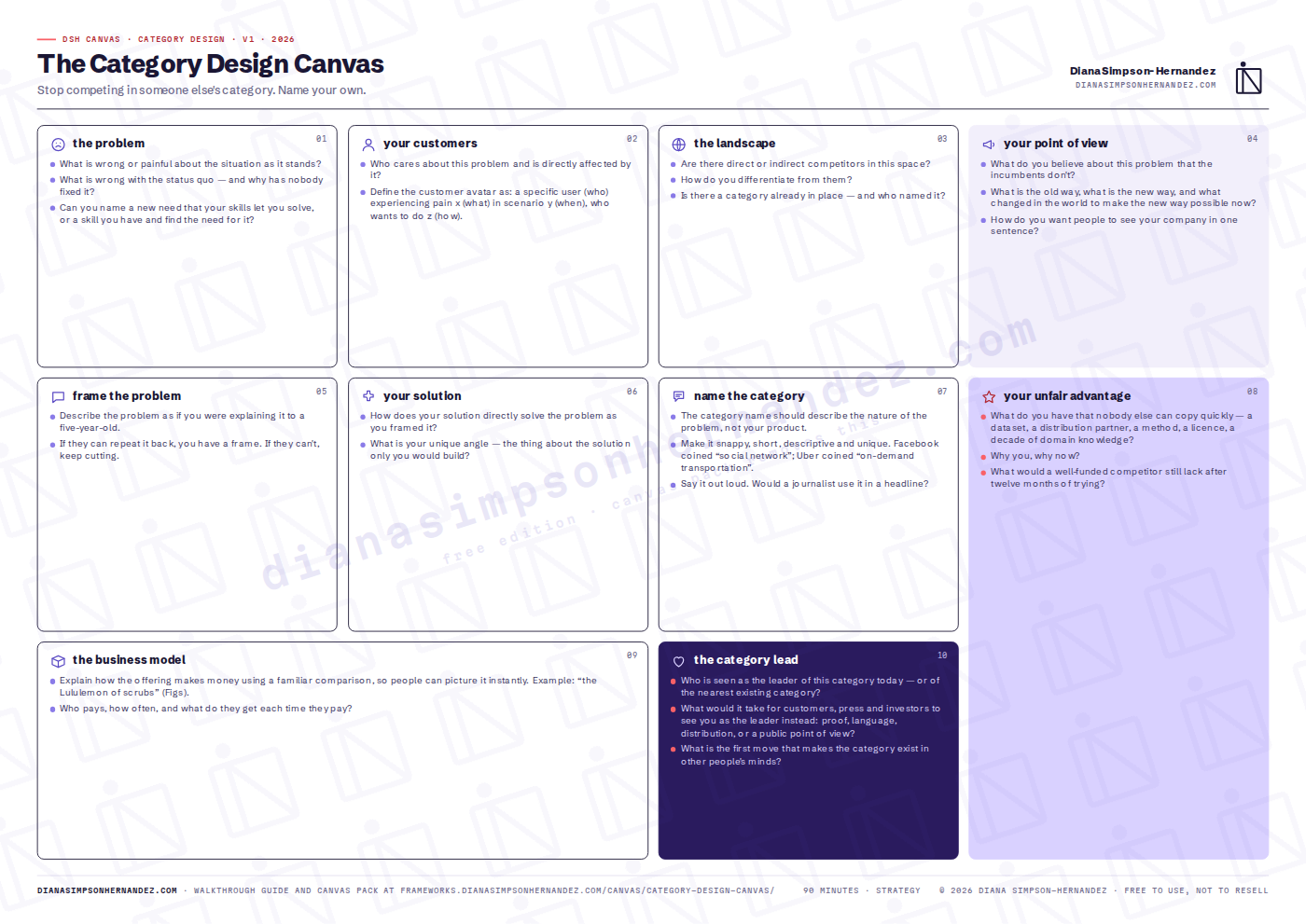
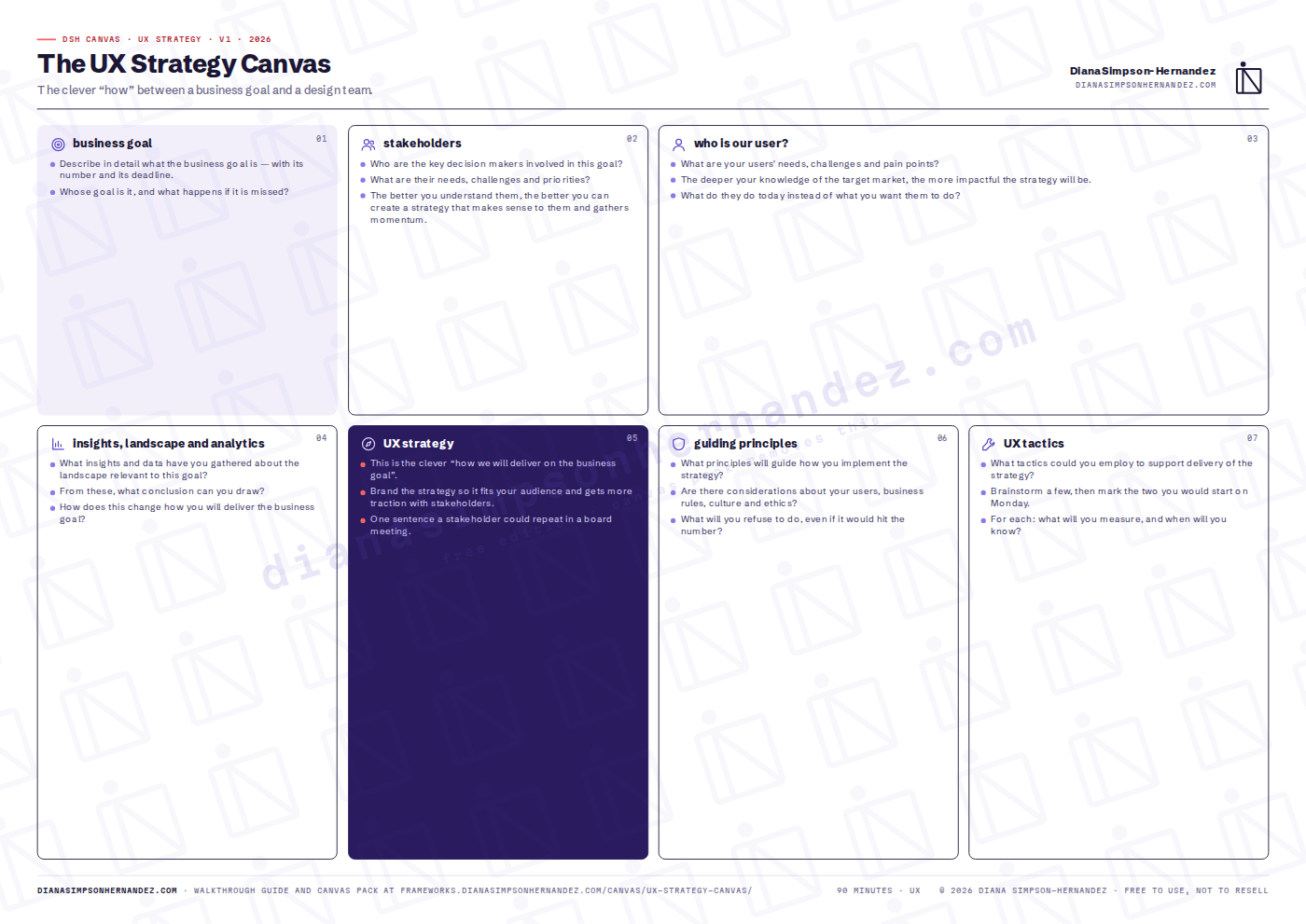
Take the gap rows into the Category Design Canvas (they are your problem statement) and the table-stakes rows into the UX Strategy Canvas as constraints.

Can I use this with clients?

Yes — both editions. Run it in your workshops, your company and your client work. The one thing you can't do is resell the files or upload them to template marketplaces.

What does the watermark look like?

A light tiled DSH mark and the site address across the sheet. Prompts, boxes and layout are identical to the pack version. The preview above is the free edition.

Miro or FigJam?

The pack includes a 4K PNG of each canvas. Drop it on a board, lock it, and put sticky notes on top.

Do I get updates?

Pack buyers get every new version of every canvas by email. The free edition is always the current version on this page.

The collection

The other canvases